Pantry Organization Systems That Actually Stay Clean
A clean and organized pantry can completely change the way a kitchen feels and functions. When every ingredient has a place, cooking becomes easier, grocery shopping becomes more efficient, and daily kitchen routines feel less stressful. But there is one major problem with pantry organization: many systems look beautiful for a few days and then quickly become messy.
You organize cans by size, transfer dry foods into matching containers, add labels, arrange snacks into baskets, and feel proud of the result. A week later, someone puts a bag of rice in the wrong place, a cereal box gets pushed behind another container, and half-open packages begin taking over the shelves.
The solution is not simply buying more organizers. A pantry that actually stays clean needs a system based on how your household uses food.
The best pantry organization systems are practical, flexible, easy to maintain, and designed to prevent clutter before it starts. Instead of organizing your pantry only for appearance, you should create zones, control quantities, improve visibility, and make everyday items easy to reach.
In this guide, we will explore practical pantry organization systems that can remain functional and tidy for months rather than just looking good on the day you finish organizing.
Why Pantry Organization Systems Stop Working
Before creating a better pantry, it helps to understand why common organization methods fail.
One of the biggest mistakes is organizing food according to appearance rather than usage. Matching containers and decorative baskets may look attractive, but if they make frequently used ingredients difficult to access, the system will eventually break down.
Another common problem is overcrowding. Even the best shelves cannot stay organized if they are packed with more food than they can comfortably hold.
Poor visibility is another major issue. When items disappear behind larger packages, people forget what they already have. This often leads to duplicate purchases and expired food.
A pantry can also become messy when there are no defined zones. If snacks, baking ingredients, canned food, breakfast items, and cooking staples are mixed together, putting things away becomes a guessing game.
The goal is therefore not to create a perfect-looking pantry. The goal is to create a pantry that is easy to use and easy to reset.
Start With a Complete Pantry Reset
Before purchasing containers or storage bins, remove everything from the pantry.
This may seem like extra work, but it is one of the most important steps.
Place food on a nearby counter, table, or clean floor area. Group similar items together while you remove them.
For example, create groups for:
- Pasta
- Rice and grains
- Canned food
- Breakfast foods
- Snacks
- Baking ingredients
- Spices
- Sauces
- Cooking oils
- Tea and coffee
- Dry beans and lentils
- Pet food if stored in the pantry
- Back-up or bulk supplies
As you remove each item, check its condition and expiration date.
Throw away anything that is expired, damaged, leaking, or clearly no longer usable.
You may also discover that you own three bottles of the same sauce or several unopened packages of the same ingredient.
This information is valuable because it shows you how your pantry is actually being used.
Create Pantry Zones
One of the most effective systems is dividing the pantry into clearly defined zones.
Instead of randomly placing products wherever there is space, give every category a home.
A simple pantry zone system might look like this:
Zone 1: Everyday Essentials
Keep the ingredients you use almost every day at eye level.
This could include:
- Rice
- Pasta
- Cooking oils
- Flour
- Sugar
- Tea
- Coffee
- Breakfast items
- Frequently used spices
These products should be easy to grab without moving other items.
Zone 2: Snacks
Create one dedicated area for snacks.
Use bins or baskets to hold:
- Chips
- Crackers
- Granola bars
- Cookies
- Nuts
- Dried fruit
A dedicated snack zone prevents individual packets from spreading across multiple shelves.
Zone 3: Baking
Keep baking ingredients together.
This may include:
- Flour
- Sugar
- Baking powder
- Baking soda
- Cocoa
- Chocolate chips
- Sprinkles
- Cake decorations
Using one shelf or container group for baking makes cooking much easier.
Zone 4: Canned Goods
Canned food is ideal for organized shelving because cans are uniform and easy to group.
Arrange them by category rather than simply stacking them randomly.
For example:
- Vegetables
- Beans
- Soups
- Tomatoes
- Fruit
- Fish or meat products
If you have deep shelves, can organizers can improve visibility considerably.
Zone 5: Backstock
Backstock means extra products that are not currently being used.
Instead of mixing backup supplies with everyday items, create a dedicated area for them.
This is especially useful for:
- Extra pasta
- Large rice bags
- Paper products
- Extra sauces
- Bulk snacks
- Unopened cereal
- Backup cleaning supplies
The key rule is simple: use the open product before opening the backup.
Use the “First In, First Out” Method
Restaurants and professional kitchens often use a simple principle called FIFO: First In, First Out.
The idea is that older food should be used before newer food.
You can apply the same method at home.
When you purchase a new package of pasta, rice, cereal, or canned food, place it behind the older package.
That way, the older product naturally moves toward the front.
This small habit can reduce food waste and prevent forgotten items from sitting at the back of the pantry for months.
For products with expiration dates, periodically move the items with earlier dates toward the front.
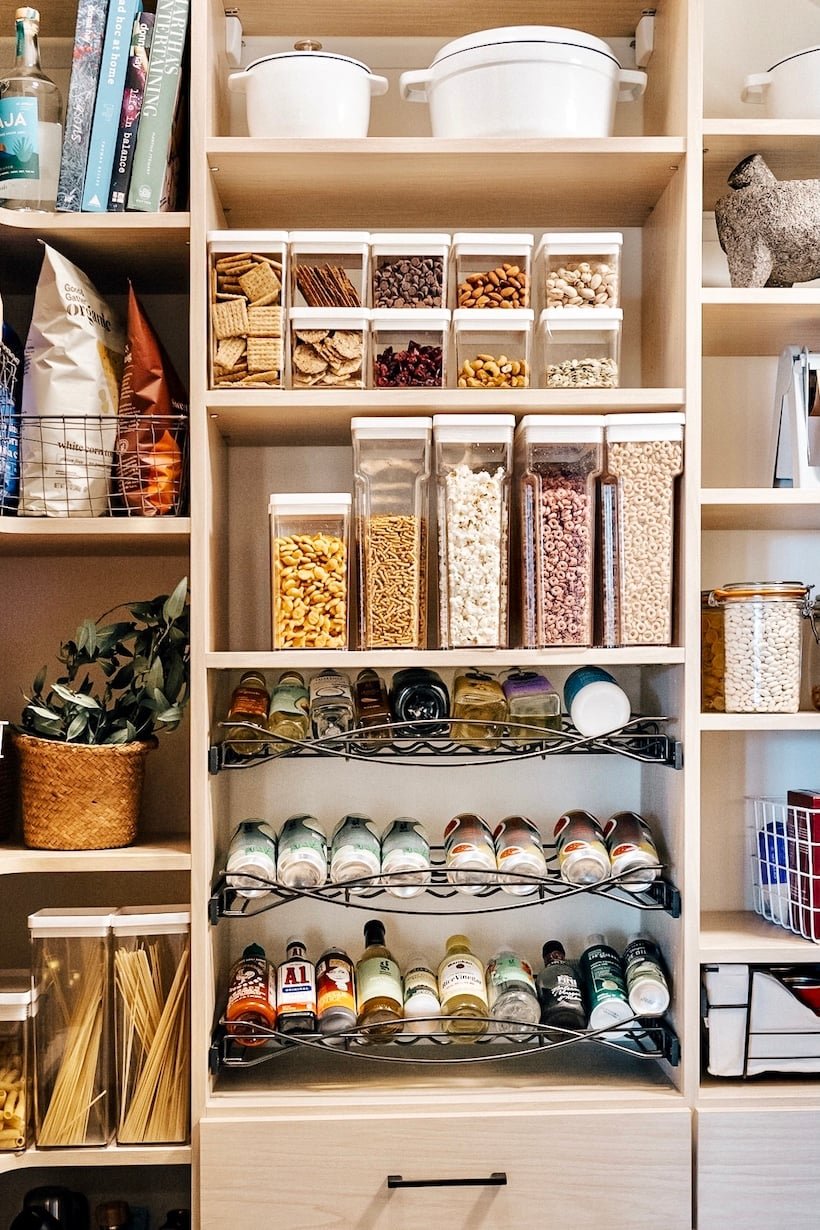
Use Clear Containers Strategically
Clear containers can be extremely useful, but you do not need to transfer everything into them.
This is an important distinction.
Some people become overwhelmed because they believe a perfectly organized pantry requires dozens of matching containers.
It does not.
Use clear containers for foods where visibility and easy access genuinely help.
Good candidates include:
- Rice
- Pasta
- Flour
- Sugar
- Oats
- Cereal
- Lentils
- Beans
- Nuts
- Seeds
- Dried fruit
Clear containers make it easy to see how much food remains.
They also create consistent shapes, which can make shelves easier to arrange.
However, products that are already packaged conveniently may not need to be transferred.
Choose Containers Based on Your Habits
The best storage container is not necessarily the most expensive one.
Before buying containers, consider how you use the food.
If you frequently cook rice, choose a container that makes it easy to scoop rice.
If your family eats cereal every morning, choose a container that opens easily.
If children frequently reach for snacks, use accessible bins instead of containers with complicated lids.
A beautiful container that nobody wants to use is not a successful organization solution.
Avoid Overfilling Containers
One common pantry mistake is filling every container to maximum capacity.
This may look efficient, but it can make your system harder to maintain.
Leave a little space at the top of containers.
This makes it easier to scoop food, refill containers, and see how much remains.
It also prevents ingredients from spilling when the container is moved.
Label What Matters
Labels can dramatically improve pantry organization.
However, labeling every tiny item may create unnecessary work.
Focus on containers where the contents are not immediately obvious.
Labels are especially useful for:
- Flour
- Sugar
- Different types of rice
- Different types of pasta
- Baking ingredients
- Similar-looking grains
- Pet food
- Bulk ingredients
Simple labels are usually enough.
You can use printed labels, handwritten labels, chalk labels, or adhesive labels.
The important thing is consistency.
Use Bins to Control Small Packages
Small packages are some of the biggest sources of pantry clutter.
Individual snack packets, seasoning packets, drink mixes, and small baking products can easily become scattered.
Bins solve this problem by creating boundaries.
Instead of allowing small items to occupy the entire shelf, place them inside a container.
For example, you might have:
- Breakfast bin
- Snack bin
- Baking extras bin
- Sauce packet bin
- Lunchbox bin
The bin becomes the designated space.
If the bin is full, that is a signal that you have too much of that category.
Use Vertical Space
Many pantries waste valuable vertical space.
If there is a large gap between shelves, consider adding shelf risers.
Shelf risers create an additional level for smaller products.
They work particularly well for:
- Cans
- Jars
- Spices
- Small boxes
- Condiments
Instead of stacking products several layers deep, use vertical organization to keep them visible.
Install an Adjustable Shelf System
If your pantry has fixed shelves that create awkward spaces, adjustable shelving can make a major difference.
Shelves should be positioned according to the items you store.
Tall bottles need more vertical clearance.
Small cans and jars need much less.
Adjustable shelves allow you to reduce wasted space and make better use of the entire pantry.
If a renovation is not practical, removable shelf risers can provide a similar benefit.
Use the Door for Extra Storage
The pantry door is often an underused storage area.
A door-mounted organizer can hold smaller items that would otherwise consume shelf space.
Good door-storage candidates include:
- Spices
- Sauces
- Small snacks
- Wraps
- Foil
- Baking supplies
- Measuring tools
However, avoid putting extremely heavy products on the door unless the door and organizer are designed to support them.
Create a Dedicated Breakfast Zone
If your household has a regular breakfast routine, create a breakfast station inside the pantry.
Keep related items together.
For example:
- Cereal
- Oats
- Granola
- Coffee
- Tea
- Sweeteners
- Peanut butter
- Jam
This allows everyone to find breakfast ingredients quickly.
It also reduces the number of places people search for food in the morning.
Create a Lunchbox Station
Families with children can benefit from a dedicated lunchbox zone.
Store lunch-related products together:
- Snack bars
- Crackers
- Nuts
- Dried fruit
- Small packets
- Juice boxes
- Reusable containers
This system makes packing lunches faster and reduces the chance of small food items becoming scattered throughout the pantry.
Keep Heavy Items Low
Heavy products should generally be stored on lower shelves.
Examples include:
- Large rice bags
- Flour bags
- Bulk beverage containers
- Large jars
- Heavy appliances
Keeping heavy items low makes them easier and safer to remove.
It also prevents upper shelves from becoming difficult to access.
Keep Frequently Used Items at Eye Level
The most valuable pantry space is usually between waist and eye level.
Use this area for the items you reach for most often.
Less frequently used products can go higher or lower.
For example:
Eye level: everyday cooking ingredients
Middle shelf: snacks and breakfast products
Lower shelf: bulk items and heavy supplies
Upper shelf: occasional-use ingredients and backups
This creates a natural hierarchy.
Use Lazy Susans for Difficult Corners
Corner shelves can be frustrating because products disappear into the back.
A rotating tray, often called a lazy Susan, can solve this problem.
It works particularly well for:
- Sauces
- Oils
- Vinegar
- Spices
- Small jars
Instead of reaching behind several bottles, rotate the tray and bring the item forward.
Use Pull-Out Bins for Deep Shelves
Deep pantry shelves can create a visibility problem.
Items at the front hide products behind them.
Pull-out bins solve this by allowing an entire category to slide forward.
For example, one pull-out bin could contain:
- Pasta
- Another could contain snacks
- Another could contain baking products
This is especially helpful in deep cabinets where reaching the back is difficult.
Don’t Store Too Many Categories Together
A common mistake is creating categories that are too broad.
For example, a single basket labeled “Food” is not useful.
A better system separates products according to how they are used.
Instead of:
Food
Try:
Snacks
Breakfast
Baking
Cooking Staples
Lunchbox
The more logical the categories are, the easier it becomes to maintain the pantry.
Make the System Easy for Everyone
A pantry will only stay organized if everyone who uses it understands the system.
This means you should avoid overly complicated arrangements.
If someone needs a diagram to understand where the cereal belongs, the system may be too complicated.
Keep categories intuitive.
Everyone should know:
- Where snacks go
- Where cereal goes
- Where cans go
- Where extra supplies go
- Where opened packages go
Simple systems are more sustainable than complicated ones.
Create an “Open First” Area
One clever system is creating a small area for food that needs to be used soon.
This could be a basket labeled:
Eat First
Use it for products that are:
- Near expiration
- Already opened
- Leftover ingredients
- Partially used packages
This makes forgotten food visible and encourages the household to use it before buying more.
Organize Spices by Frequency
Spices can become one of the messiest pantry categories.
Instead of arranging them alphabetically, consider organizing them by frequency of use.
Keep everyday spices near the front:
- Salt
- Black pepper
- Chili powder
- Paprika
- Garlic powder
- Cumin
Less frequently used spices can be placed farther back or higher.
If you have many spices, a tiered rack can make labels easier to see.
Store Pasta and Grains Vertically
Long packages of pasta can be awkward.
Instead of allowing them to lean against other items, store them vertically in tall containers or bins.
Rice, grains, and lentils can be stored in stackable containers.
This creates a cleaner visual structure and makes measuring easier.
Don’t Forget Cleaning and Maintenance
A pantry is still a food-storage area, so cleanliness matters.
Every few weeks, wipe shelves and check for crumbs, spills, or leaking packages.
A simple maintenance routine might take only 10 minutes.
Remove everything from one shelf.
Wipe it.
Check expiration dates.
Return the products to their zones.
You do not need to completely reorganize the pantry every time.
Create a Weekly Five-Minute Reset
A five-minute weekly reset can prevent major pantry messes.
Choose one day of the week.
During the reset:
- Return misplaced items.
- Close open packages.
- Move older products forward.
- Check for spills.
- Remove empty boxes.
- Combine duplicate open packages when appropriate.
- Make a quick grocery list.
This small routine can save you from having to perform a huge pantry cleanout later.
Avoid Buying Organizers Before Measuring
One of the biggest mistakes in pantry organization is buying containers first.
Measure your shelves.
Record:
- Shelf width
- Shelf depth
- Shelf height
- Door clearance
- Available corner space
Then choose organizers that fit.
An organizer that is one inch too large can become useless.
Measure twice and shop once.
Use Matching Containers Carefully
Matching containers create visual consistency, but functionality should come first.
If you choose containers, consider:
- Easy opening
- Stackability
- Durability
- Cleaning
- Capacity
- Transparency
- Shape
Rectangular containers often make better use of shelf space than round containers because they create fewer gaps.
Use Narrow Containers for Narrow Spaces
Not every pantry shelf needs large storage bins.
Narrow spaces can be used for:
- Spice jars
- Small sauces
- Packets
- Tea
- Baking decorations
Rather than leaving these gaps unused, use slim organizers designed for narrow spaces.
Create a Grocery Restocking System
A clean pantry depends partly on how groceries enter the house.
When you bring groceries home, avoid simply putting everything wherever you see space.
Instead:
- Check existing stock.
- Move older items forward.
- Put new products behind them.
- Refill containers if necessary.
- Put backup products in the backstock zone.
This takes a few extra minutes but keeps the pantry organized automatically.
Keep Bulk Buying Under Control
Buying in bulk can save money, but only if you have enough storage space.
A pantry becomes difficult to manage when bulk purchases exceed available capacity.
Before buying a large package, ask:
Do I actually have room for this?
If the answer is no, buying a smaller quantity may create a better overall system.
Organization is not about fitting the maximum amount of food into your pantry. It is about making the available food easy to access.
Use a Pantry Inventory List
A simple inventory list can prevent overbuying.
You do not need to track every single item.
Focus on staples.
For example:
- Rice
- Flour
- Sugar
- Pasta
- Cooking oil
- Lentils
- Beans
- Canned tomatoes
- Tea
- Coffee
When something gets low, add it to your grocery list.
This reduces duplicate purchases.
Use Technology if It Helps
Some households benefit from digital inventory apps or simple notes on a phone.
You can maintain a basic list of pantry staples and update it when products run low.
However, technology should make your system easier, not more complicated.
A handwritten list on the refrigerator may be just as effective.
Keep Emergency Supplies Separate
If you keep emergency food or long-term supplies, separate them from everyday pantry products.
A clearly labeled backup zone prevents accidental consumption of supplies you intended to keep.
It also makes it easier to check quantities.
Make Kids’ Food Accessible
If children regularly use the pantry, create a child-friendly snack area.
Place appropriate snacks at a reachable height.
Use open bins or easy-access baskets.
For example:
Kids’ Snacks
School Snacks
Breakfast
This gives children independence while keeping food organized.
Use Transparent Bins for Visibility
Clear bins are particularly useful when you want to see what is inside without opening them.
They work well for:
- Snack packets
- Baking supplies
- Small jars
- Meal-prep ingredients
- Lunchbox products
If using opaque bins, labels become more important.
Avoid Creating a “Miscellaneous” Zone
A miscellaneous basket can quickly become a dumping ground.
If you repeatedly place random products in one basket, it becomes difficult to find anything.
Instead, ask why the items do not have a proper category.
If necessary, create a new category.
Give Every Item a Home
This is the central rule of a pantry that stays clean.
Every item should have a logical place.
When something does not have a home, it gets placed wherever there is room.
That is how clutter begins.
A good system makes the correct location obvious.
Think About Cleaning When Designing the Pantry
Storage systems should not make cleaning difficult.
Avoid creating unnecessary tiny gaps where crumbs and dust can collect.
Containers should be removable.
Bins should be washable.
Shelves should remain accessible.
The easiest pantry to clean is the one with simple, accessible storage.
Don’t Sacrifice Function for Aesthetics
A pantry can look beautiful without being impractical.
But appearance should support function rather than replace it.
For example, a beautiful glass jar may look great but be inconvenient for a food you use several times every day.
A simple plastic container might work better.
The best pantry is one that looks organized because it functions well.
Use a “One In, One Out” Rule
For certain pantry categories, the one-in-one-out rule can be useful.
If you already have three opened boxes of cereal, don’t buy another until one is finished.
If you purchase a new snack variety, consider whether an older product should be finished first.
This keeps quantities under control.
Organize According to Cooking Habits
Every household uses its pantry differently.
If you cook Asian dishes frequently, you may need dedicated areas for rice, noodles, sauces, and spices.
If you bake often, baking ingredients may deserve prime pantry space.
If you mostly prepare quick meals, sauces, canned foods, pasta, and grains may be more important.
Do not copy someone else’s pantry system exactly.
Use their principles, then customize the categories to your lifestyle.
Make Meal Planning Part of Pantry Organization
Meal planning can help keep the pantry under control.
Before grocery shopping, check what you already have.
Build meals around ingredients that need to be used.
This prevents food from accumulating.
It also reduces the number of duplicate products.
A well-organized pantry should support your meal-planning routine.
Use Color Coding if Helpful
Color coding can make categories easier to recognize.
For example:
- One label color for baking
- One for snacks
- One for breakfast
- One for cooking staples
This is optional, but it can help busy households quickly identify categories.
Avoid Overly Deep Stacks
Stacking cans or packages can save space, but too much stacking reduces accessibility.
If you have to remove five products to reach the one at the bottom, the system is not efficient.
Use organizers that create levels when necessary.
The ideal arrangement allows you to see and reach most items without moving several others.
Create a “Refill” Routine
If you use storage containers, establish a simple refill routine.
When a container is nearly empty:
- Check the backstock.
- Refill the container.
- Move the new package into the backstock area.
- Clean the container if necessary.
This prevents half-empty bags from accumulating around the pantry.
Consider Food Safety
Pantry organization should also support food safety.
Keep food in clean, sealed containers when appropriate.
Do not use damaged containers.
Clean up spills immediately.
Check products regularly for insects, moisture, mold, or unusual odors.
Keep cleaning chemicals and other non-food products away from food whenever possible.
The Best Pantry System Is the One You Can Maintain
There is no single perfect pantry organization system.
A system succeeds when your household can maintain it without constant effort.
If organizing the pantry takes hours every week, simplify it.
If labels keep falling off, use a different labeling method.
If containers are inconvenient, replace them.
If everyone keeps putting snacks in the wrong place, move the snack zone somewhere more intuitive.
The system should adapt to your household.
A Simple Pantry Organization Formula
If you are starting from scratch, use this basic formula:
1. Declutter
Remove expired, damaged, and unwanted products.
2. Categorize
Group similar products together.
3. Create zones
Give every category a designated area.
4. Prioritize access
Put frequently used products at eye level.
5. Improve visibility
Use clear containers, risers, and pull-out bins where useful.
6. Control quantity
Avoid overcrowding and excessive bulk purchases.
7. Label strategically
Label containers and bins when contents are not obvious.
8. Maintain
Do a quick weekly reset and deeper monthly check.
Example of a Practical Pantry Layout
A medium-sized pantry could be organized like this:
Top Shelf
Occasional-use products and extra supplies.
Eye-Level Shelf
Daily cooking ingredients, breakfast foods, and frequently used products.
Middle Shelf
Snacks, canned foods, sauces, and meal ingredients.
Lower Shelf
Rice bags, flour, bulk products, and heavy items.
Pantry Door
Spices, wraps, small sauces, and packets.
Pull-Out Bins
Special categories such as baking, lunchbox supplies, or snacks.
This arrangement is only an example. Your pantry should reflect your own cooking habits.
Monthly Pantry Maintenance
Once a month, spend approximately 15–20 minutes doing a deeper check.
Look for:
- Expired food
- Open packages
- Empty containers
- Spills
- Duplicate purchases
- Damaged packaging
- Products that need to be used soon
Rotate older products toward the front.
Wipe shelves where needed.
Review your storage system.
If something repeatedly becomes messy, don’t simply clean it again. Ask why it keeps happening.
The answer may reveal a flaw in your system.
Seasonal Pantry Organization
Your pantry may also change with the seasons.
During colder months, you may use more:
- Soups
- Baking ingredients
- Hot drinks
- Grains
During warmer months, you may use more:
- Snacks
- Cold drinks
- Salad ingredients
- Quick-cooking foods
Adjust your most accessible shelves accordingly.
There is no reason to keep the same arrangement all year if your habits change.
How to Make Pantry Organization Last
The secret to long-lasting pantry organization is reducing the number of decisions required.
If people have to think about where something belongs, they may put it somewhere random.
If the location is obvious, they are more likely to return it correctly.
This is why zones, labels, bins, and clear categories work together.
A successful system should answer three questions immediately:
Where does this belong?
Can I see what I have?
Can I reach it easily?
If the answer to all three is yes, your pantry is likely to remain organized.
Final Thoughts
A pantry that stays clean is not created by buying the most expensive containers or copying a picture-perfect pantry from social media.
It is created by building a system around real-life habits.
Start by removing unnecessary items. Group similar foods together. Create practical zones. Keep frequently used ingredients within easy reach. Use clear containers and bins where they genuinely improve organization. Keep heavy products low, use vertical space efficiently, and maintain a simple first-in, first-out system.
Most importantly, make the system easy for everyone in the household to understand.
A pantry should support your kitchen rather than create additional work.
The best organization system is one that still works after a busy week, after grocery shopping, after cooking several meals, and after everyone in the house has used it.
When every item has a home, quantities are controlled, products remain visible, and maintenance becomes part of your normal routine, pantry organization stops being a one-time project and becomes a sustainable everyday system.
A clean pantry is not about perfection. It is about making your kitchen easier to use, easier to maintain, and less stressful every day.