Compact Breakfast Nook Ideas for Small Kitchen Corners
A small kitchen does not have to mean giving up on the comfort and charm of a dedicated breakfast area. Even the narrowest kitchen corner can become a practical, welcoming breakfast nook with the right furniture, layout, lighting, and storage choices. A compact breakfast nook can provide a cozy place for morning coffee, quick breakfasts, family conversations, homework, remote work, or evening snacks without taking over valuable kitchen space.
The key is to work with the dimensions you already have rather than trying to force a full-sized dining setup into a limited area. Smart seating, multifunctional furniture, wall-mounted tables, benches, folding surfaces, and thoughtful storage can transform an unused corner into one of the most useful parts of your kitchen.
In this guide, we will explore practical and stylish compact breakfast nook ideas for small kitchen corners. Whether you live in a studio apartment, a small house, a townhouse, or a compact urban home, these ideas can help you create a breakfast space that feels comfortable without making your kitchen feel crowded.
Why Create a Breakfast Nook in a Small Kitchen?
A breakfast nook is more than just a place to eat breakfast. It can become a flexible zone that serves several purposes throughout the day.
In a large home, dining and kitchen spaces are often separated. In a small home, however, combining functions is usually more practical. A breakfast nook can act as a dining area in the morning, a work area during the afternoon, and a relaxing spot in the evening.
One of the biggest advantages is that a nook can use space that would otherwise remain unused. Corners, windowsides, empty walls, and awkward spaces between cabinets can all potentially become useful dining areas.
A compact breakfast nook can also make a kitchen feel more personal. Instead of filling the room with large furniture, you can create a small, intentional seating area that adds character while preserving movement space.
1. Use a Corner Bench to Maximize Seating
One of the most effective ideas for a small breakfast nook is a corner bench.
A traditional table with four individual chairs requires space behind every chair so people can pull them out. A built-in or freestanding corner bench reduces the amount of clearance needed.
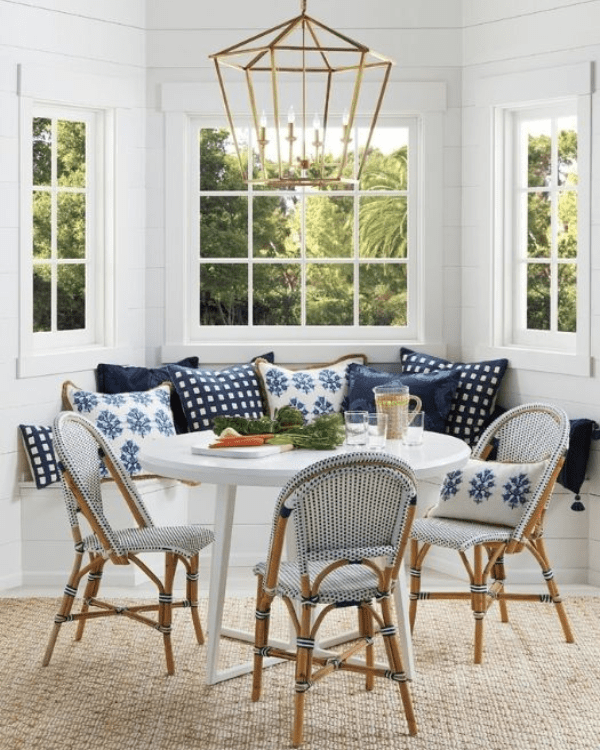
An L-shaped bench can fit naturally into the corner of a kitchen. Place a small rectangular or square table in front of it and add one or two lightweight chairs on the opposite side.
The bench can also provide hidden storage underneath. A lift-up seat can conceal kitchen linens, small appliances, serving dishes, children’s supplies, or rarely used cookware.
For an even cleaner appearance, choose a bench with drawers instead of a lift-up lid. Drawers allow you to access stored items without moving cushions or clearing the seat.
2. Build a Breakfast Nook Under a Window
A kitchen window can provide the perfect backdrop for a breakfast nook.
Instead of leaving the area below a window unused, install a narrow bench underneath it. Add cushions, a small table, and compact chairs to create a bright dining corner.
Natural light can make even a tiny nook feel larger. Morning sunlight is especially useful for creating a pleasant breakfast atmosphere.
Keep window treatments simple. Roman shades, roller shades, or lightweight curtains can provide privacy without visually overwhelming the space.
If the window has a beautiful outdoor view, avoid blocking it with tall furniture. A low bench will preserve the view while providing comfortable seating.
3. Choose a Round Table for Tight Corners
When space is extremely limited, a round table can be more practical than a rectangular one.
A round table eliminates sharp corners and can make movement around the nook easier. It is especially useful in kitchens where the breakfast area sits near a walkway.
A small pedestal table is another smart option. Traditional tables with four legs can interfere with people’s feet, while a central pedestal creates more usable legroom.
For two people, a compact round table can be enough for breakfast, coffee, laptops, or casual meals.
4. Try a Wall-Mounted Drop-Leaf Table
A wall-mounted folding table is one of the best solutions for an extremely small kitchen.
When you need the table, simply fold it down. When breakfast is finished, fold it against the wall.
This design is particularly useful in studio apartments, narrow kitchens, and kitchens where a permanent table would interfere with cabinet doors or walking paths.
You can make the area more functional by installing shelves above the table. Keep everyday items such as mugs, tea, coffee, napkins, and small dishes within easy reach.
When choosing a folding table, make sure the wall structure can safely support it and that the hardware is appropriate for the table’s weight.
5. Install a Narrow Breakfast Counter
Another excellent idea is to create a slim counter along an empty kitchen wall.
A narrow countertop can function as a breakfast bar without requiring a traditional dining table. Pair it with two compact stools that can slide completely underneath.
This arrangement works especially well in kitchens with limited floor space.
The counter can also become a workspace. In the morning, it can hold breakfast plates and coffee. Later, it can become a laptop station.
Choose stools without large backs if you want to maintain a visually open appearance.
6. Use a Built-In Bench Along the Wall
A simple wall bench can create a comfortable nook without consuming much space.
The bench can run along one wall while a narrow table sits directly in front of it. Because the bench is attached to or positioned against the wall, it requires less clearance than freestanding chairs.
For additional comfort, use a seat cushion and a few removable back cushions.
If you rent your home and cannot install permanent furniture, a freestanding storage bench can provide a similar effect.
7. Take Advantage of Awkward Kitchen Corners
Many small kitchens contain corners that seem impossible to furnish.
Instead of ignoring these areas, measure them carefully.
A corner between two walls can accommodate an L-shaped bench. A narrow gap beside a cabinet may work for a tiny breakfast counter. A space next to a window can hold a two-seat table.
The important thing is to measure before buying furniture.
Measure:
- Wall width
- Available depth
- Ceiling height
- Door swings
- Cabinet clearance
- Walking paths
- Window placement
- Appliance locations
Even a few centimeters can determine whether a piece of furniture feels comfortable or cramped.
8. Use Two Chairs Instead of Four
A breakfast nook does not need to accommodate the entire household at all times.
If the space is mainly used by one or two people, use a two-seat arrangement.
A small table with two chairs takes significantly less visual and physical space than a four-seat dining table.
Choose lightweight chairs that can be moved easily when additional kitchen workspace is needed.
If you occasionally need extra seating, folding chairs can be stored elsewhere and brought out when necessary.
9. Choose Stackable or Folding Chairs
Flexible furniture is especially valuable in a small kitchen.
Stackable chairs can be stored vertically when they are not being used. Folding chairs can be hung on a wall hook or placed inside a closet.
This allows the breakfast nook to change according to your needs.
For example, you might keep two chairs at the table every day and bring out additional chairs when guests arrive.
Look for chairs that are comfortable but visually light. Slim frames and open backs can help a small space feel less crowded.
10. Create a Breakfast Nook Beside the Kitchen Island
If your kitchen has an island, you may not need a separate dining table.
Extend one end of the island to create a small eating area. A slightly raised or extended countertop can provide enough room for two or three stools.
This is an efficient solution because the island already serves as a kitchen work surface.
The breakfast area becomes an extension of the kitchen rather than a separate piece of furniture.
Choose stools that fit comfortably beneath the counter when not in use.
11. Add a Slim Console-Style Dining Table
A narrow console table can sometimes work as a breakfast table.
Look for a table that is deeper than a traditional console but narrower than a standard dining table.
Place it against the wall and use stools or slim chairs.
This is particularly useful in long, narrow kitchens where width is limited but wall length is available.
The table can also double as a serving station or coffee bar.
12. Use a Fold-Out Table for Maximum Flexibility
Fold-out furniture is ideal for multifunctional kitchens.
A wall-mounted cabinet can conceal a table that folds down when needed. Some designs can even include shelves for storage.
During breakfast, the table becomes a dining surface. Afterward, it folds away.
This approach keeps the floor open and makes the kitchen feel larger.
13. Make the Breakfast Nook Part of the Pantry Area
If your kitchen has a pantry wall, consider integrating a small seating area into the design.
For example, one end of a pantry cabinet could be paired with a narrow counter and two stools.
The result is a compact breakfast station where food storage and dining happen in one zone.
Keep everyday breakfast foods nearby:
- Cereal
- Oatmeal
- Tea
- Coffee
- Bread
- Spreads
- Mugs
- Bowls
- Napkins
This can make busy mornings more efficient.
14. Create a Cozy Coffee-and-Breakfast Corner
A breakfast nook does not necessarily need to be large enough for full meals.
If your primary goal is morning coffee, tea, toast, or a quick snack, a tiny two-person corner can be enough.
Use a small round table, two compact chairs, and a wall shelf.
Add a coffee maker, mugs, and a small tray nearby.
This creates a dedicated morning ritual space without requiring a full dining area.
15. Use Vertical Space for Storage
When floor space is limited, look upward.
Walls can provide valuable storage without reducing walking space.
Install:
- Floating shelves
- Pegboards
- Wall rails
- Small cabinets
- Hooks
- Narrow display ledges
Above a breakfast nook, you can store mugs, plates, jars, cookbooks, and decorative objects.
Avoid filling every inch of wall space. A few carefully selected items can look more attractive and organized.
16. Choose Furniture With Hidden Storage
Small spaces benefit from furniture that performs multiple functions.
A storage bench is a perfect example.
Instead of using a separate cabinet for breakfast nook supplies, store them inside the bench.
You could keep:
- Tablecloths
- Napkins
- Placemats
- Board games
- Children’s books
- Reusable shopping bags
- Seasonal decorations
Hidden storage helps maintain a clean appearance.
17. Use a Pedestal Table
A pedestal table is especially useful in compact dining corners.
Because the base is located in the center, people can move their legs freely around the table.
This makes a small table feel more comfortable than a similarly sized table with four bulky legs.
A pedestal table also works well with corner benches.
18. Consider a Half-Moon Table
A half-moon or semicircular table can fit neatly against a wall.
It provides enough surface for two people while taking less floor space than a conventional table.
This is a creative option for unusually shaped kitchen corners.
Pair it with a bench or two narrow stools.
19. Use a Bistro-Style Setup
A small café-inspired breakfast nook can bring personality to a kitchen.
Choose a small round table, two chairs, and a simple pendant light.
You can create a European café atmosphere with:
- Warm wood
- Simple ceramics
- Linen cushions
- Small artwork
- Plants
- Soft lighting
The advantage of this approach is that you do not need much furniture to make the space feel intentional.
20. Add a Wall-Mounted Breakfast Bar
A wall-mounted breakfast bar can be as narrow as needed for your space.
Even a relatively shallow surface can work for coffee, toast, fruit, or a laptop.
Install it at a comfortable height and pair it with stools.
When planning the bar, make sure there is enough knee clearance underneath.
21. Use Slim Backless Stools
Backless stools are useful when every inch matters.
They can slide completely beneath a counter or table when not in use.
This keeps pathways clear and reduces visual clutter.
However, if the nook will be used for long meals or work sessions, consider stools with supportive backs instead.
Comfort should always be considered alongside space savings.
22. Add Cushions for Comfort
A small nook can feel much more inviting with comfortable cushions.
A bench cushion creates a finished appearance, while loose cushions allow you to change colors and patterns easily.
For a kitchen, choose fabrics that are easy to clean.
Washable covers are especially useful for homes with children.
Neutral cushions can create a timeless look, while patterned fabrics can add personality.
23. Use Color to Define the Nook
A breakfast nook can feel like its own zone without requiring walls.
One easy method is to use a different paint color behind the nook.
You could choose:
- Soft beige
- Warm white
- Sage green
- Muted blue
- Terracotta
- Pale gray
The color should complement the kitchen while visually distinguishing the seating area.
24. Create a Small Accent Wall
If you want more visual impact, create an accent wall behind the breakfast nook.
Wallpaper, textured paint, wood paneling, or decorative tile can help define the area.
In a small kitchen, however, avoid overly busy patterns unless the rest of the room is relatively simple.
A small accent wall can create a focal point without overwhelming the room.
25. Use a Round Mirror to Make the Nook Feel Larger
A mirror can visually expand a compact breakfast corner.
A round mirror above a bench or small table can reflect light and create a sense of depth.
Place it where it reflects a window or another attractive part of the kitchen.
Avoid positioning the mirror where it reflects clutter or frequently used work areas.
26. Add a Small Pendant Light
Lighting can make a breakfast nook feel intentional.
A pendant light above the table provides focused illumination and creates a visual boundary around the eating area.
Choose a fixture that fits the scale of the space.
A huge pendant can make a tiny nook feel crowded, while a small fixture may provide enough style without dominating the room.
27. Use Warm Lighting
Warm light is especially appropriate for breakfast nooks because it creates a cozy atmosphere.
Choose warm-toned bulbs or fixtures designed for comfortable residential lighting.
You can combine overhead lighting with a small wall sconce or under-shelf light.
Layered lighting allows the nook to remain useful throughout the day.
28. Add Plants for Freshness
A small plant can bring life to a breakfast corner.
Use a windowsill, wall shelf, or tabletop to display greenery.
Good choices depend on your available natural light and ability to care for plants.
If the kitchen receives limited sunlight, consider plants that tolerate lower-light conditions or use realistic artificial greenery.
Keep plants away from areas where water or cooking splashes could become a problem.
29. Keep the Table Surface Simple
Small spaces can quickly look cluttered.
Avoid turning the breakfast table into permanent storage.
Instead, keep only a few decorative or practical items on the surface.
A small vase, fruit bowl, or simple tray can be enough.
When the table is clear, the entire kitchen will generally feel more organized.
30. Use a Tray to Organize Breakfast Essentials
A tray can make a compact breakfast nook more functional.
Keep coffee, tea, sugar, napkins, or condiments together on the tray.
When needed, the entire collection can be moved easily.
This is particularly useful when the breakfast nook doubles as a workspace.
31. Turn the Nook Into a Homework Station
Families can get more value from a breakfast nook by making it multifunctional.
During breakfast, it is a dining area.
After school, it becomes a homework station.
Add:
- A comfortable chair
- Good lighting
- A small drawer
- Wall organizers
- A charging outlet
Make sure the workspace does not interfere with food preparation.
32. Create a Small Work-From-Home Spot
A breakfast nook can also function as a compact home office.
Choose a table with enough depth for a laptop and notebook.
Use a supportive chair if you expect to work there for extended periods.
Install cable management underneath the table to keep chargers organized.
When the workday ends, clear the workspace so it can return to its role as a dining area.
33. Use a Window Seat With a Tiny Table
If your kitchen has a deep window area, a window seat can become the centerpiece of your breakfast nook.
Add a small movable table.
This arrangement provides flexibility because the table can be moved when the space is needed for something else.
The window seat can also serve as casual reading or relaxing space.
34. Choose Light-Colored Furniture
Light colors can make small rooms feel more open.
White, cream, light wood, beige, and pale gray furniture can visually reduce the weight of a breakfast nook.
This does not mean everything must be white.
You can introduce contrast through cushions, artwork, plants, or small decorative accessories.
35. Use Matching Materials
A breakfast nook will look more integrated when its materials relate to the kitchen.
For example, if the kitchen has oak cabinets, consider a table or bench with a similar wood tone.
If the kitchen uses black metal accents, repeat black in the table legs or lighting fixture.
Repeating materials creates visual continuity.
36. Use a Narrow L-Shaped Table
An L-shaped table can work surprisingly well in corners.
One side can provide seating while the other section remains available for food or work.
This is especially useful in kitchens where a traditional rectangular table would block movement.
37. Install Floating Shelves Above the Bench
Floating shelves can add storage without consuming floor space.
Use them for decorative dishes, mugs, small plants, or cookbooks.
Avoid storing too many items because open shelving can quickly become visually busy.
A simple arrangement of useful and attractive objects usually works best.
38. Add Hooks Beneath Shelves
Hooks are useful for mugs, towels, small baskets, or lightweight kitchen accessories.
Installing hooks beneath a shelf creates another layer of vertical storage.
This can keep frequently used items accessible without requiring another cabinet.
39. Use a Narrow Storage Cabinet Beside the Nook
If you have a small amount of extra wall space, a slim cabinet can provide valuable storage.
Use it for breakfast supplies or dining accessories.
Choose a cabinet with doors if you want a clean, uncluttered appearance.
Open shelving works better if you are comfortable maintaining an organized display.
40. Make the Nook Kid-Friendly
A breakfast nook can be especially useful for families.
Choose durable surfaces and easy-to-clean fabrics.
Avoid fragile decorative pieces.
A rounded table can reduce sharp corners, while a bench can allow children to sit together comfortably.
Add a small basket for children’s books or activities.
41. Use a Bench With Drawers
Drawers underneath a bench provide convenient storage without requiring you to lift the seat.
This can be particularly helpful for frequently used items.
Label drawers if the storage is shared among family members.
42. Consider a Built-In Banquette
A banquette is one of the most space-efficient breakfast nook designs.
It can be customized to the exact dimensions of the kitchen.
A professional carpenter can create a banquette that fits around walls, windows, radiators, or architectural features.
Built-in designs are usually more expensive than freestanding furniture, but they can make excellent use of awkward spaces.
43. Use an Extendable Table
If you regularly host guests, an extendable table can solve the problem of limited everyday space.
Keep it compact during normal use.
Extend it when additional people arrive.
This gives you flexibility without dedicating valuable floor space to a large table every day.
44. Create a Scandinavian-Inspired Nook
A Scandinavian-inspired breakfast nook can work beautifully in small kitchens.
Use:
- Light wood
- Simple furniture
- Neutral colors
- Natural fabrics
- Minimal decoration
- Soft lighting
The overall effect should be calm, functional, and uncluttered.
45. Try a Modern Minimalist Look
Minimalism is naturally suited to compact spaces.
Choose furniture with clean lines and avoid unnecessary decoration.
A small table, two chairs, a simple pendant, and one piece of wall art may be enough.
The goal is not to make the nook empty but to make every element purposeful.
46. Add Personality With Artwork
Artwork can transform a plain corner.
Choose one medium-sized piece rather than filling the wall with many small frames.
Food illustrations, botanical prints, abstract artwork, or family photography can all work.
Make sure the artwork is positioned safely away from cooking splashes.
47. Use a Rug to Define the Space
A small rug can visually separate the breakfast nook from the kitchen.
Choose a low-profile, washable rug that is easy to clean.
Avoid thick rugs that make chairs difficult to move.
Round rugs work particularly well beneath round tables.
48. Keep Walkways Clear
One of the most important rules for a small kitchen is maintaining circulation.
A beautiful breakfast nook is not successful if people constantly bump into chairs.
Before installing furniture, mark the proposed footprint with painter’s tape.
Walk around it several times.
Open nearby cabinet doors and appliances.
Pull chairs out.
This simple test can reveal problems before you buy anything.
49. Consider the Height of Everything
Furniture proportions matter in compact spaces.
A table that is too large or too tall can dominate a small corner.
Likewise, oversized chairs can make the nook uncomfortable.
Measure the height and depth of the furniture and compare it with the kitchen’s scale.
50. Use Transparent or Open Furniture
Transparent materials can reduce visual weight.
A glass tabletop, acrylic chair, or open-frame stool may help the room feel less crowded.
However, consider durability and maintenance before choosing these materials.
51. Use a Small Drop-Leaf Dining Table
A drop-leaf table gives you two configurations.
Keep the leaves down when the nook is not in use.
Raise one or both sides during meals.
This is an excellent choice for a kitchen that needs to change throughout the day.
52. Create a Breakfast Nook in a Corner Between Cabinets
Sometimes the perfect nook is hidden between existing cabinets.
If there is enough wall space, install a bench or narrow counter.
Use the surrounding cabinetry as storage.
This creates a cohesive look because the nook feels like part of the original kitchen design.
53. Use Custom Cushions
Custom cushions can make an unusual bench much more comfortable.
Measure carefully before ordering.
Choose removable covers so they can be cleaned.
For a sophisticated look, coordinate the cushion fabric with curtains, rugs, or other kitchen textiles.
54. Add a Small Shelf for Breakfast Supplies
A tiny shelf can hold everything needed for quick breakfasts.
Place coffee, tea, cereal, honey, or jam in attractive containers.
This creates a mini breakfast station.
Keep only frequently used items there to prevent clutter.
55. Make Use of the Corner Above the Nook
The vertical area above the table is often overlooked.
You can use it for:
- Artwork
- Shelves
- A clock
- A small mirror
- Hanging plants
- Decorative plates
The right wall treatment can make the nook feel complete.
56. Use Coordinated Seating
Different chairs can add personality, but matching seating often makes a small space feel more organized.
Two identical chairs create symmetry.
Alternatively, use a bench on one side and two matching stools on the other.
57. Add a Small Charging Station
If the nook doubles as a workspace, a charging station can be extremely useful.
Install or position charging access near the table.
Keep cables organized underneath.
This prevents chargers from spreading across the kitchen.
58. Choose Easy-Care Materials
Kitchen furniture is exposed to food, drinks, steam, and frequent cleaning.
Choose surfaces that are easy to wipe.
Durable laminate, sealed wood, metal, and washable fabrics can be practical options.
Consider maintenance before choosing materials based purely on appearance.
59. Make the Nook Seasonal
Small decorative changes can refresh the breakfast area throughout the year.
Use fresh flowers in spring, warm textiles in winter, and lighter accessories during warmer months.
You do not need to redesign the entire nook.
Changing a cushion cover, centerpiece, or artwork may be enough.
60. Focus on Function Before Decoration
The most attractive breakfast nook will still fail if it is uncomfortable.
Start with:
- Available dimensions
- Seating needs
- Table size
- Walking clearance
- Storage requirements
- Lighting
- Materials
- Decoration
Function should come first.
How to Plan a Compact Breakfast Nook Step by Step
Creating a breakfast nook becomes easier when you follow a clear process.
Step 1: Identify the Space
Look around the kitchen for underused areas.
Check corners, windows, empty walls, and unused sections near cabinets.
Step 2: Measure Carefully
Measure the width and depth of the available area.
Also measure door and cabinet clearance.
Step 3: Decide How Many People Need Seating
Do you need seating for one, two, three, or four people?
Do not automatically choose four seats if two are enough.
Step 4: Select the Right Table
Choose a table based on the available footprint.
Round tables work well in tight spaces, while narrow rectangular tables work well along walls.
Step 5: Select Space-Saving Seating
Consider:
- Benches
- Stools
- Folding chairs
- Stackable chairs
- Built-in banquettes
Step 6: Add Storage
Use the wall, bench, or nearby cabinets for storage.
Step 7: Plan Lighting
Make sure the nook is bright enough for eating and working.
Step 8: Add Personality
Finish the area with cushions, artwork, plants, rugs, and other small decorative details.
Common Mistakes to Avoid
Buying Furniture Before Measuring
This is one of the most common mistakes.
Always measure the available space first.
Choosing Oversized Chairs
Large chairs may make the nook feel cramped even if the table itself fits.
Blocking Cabinet Doors
Make sure chairs and benches do not interfere with nearby cabinets.
Ignoring Lighting
A dark corner may not feel inviting.
Adding Too Much Decoration
Small spaces become cluttered quickly.
Choose a few meaningful accessories instead.
Forgetting Comfort
Space-saving furniture should still be comfortable.
Using Difficult-to-Clean Fabrics
Breakfast areas naturally experience spills and crumbs.
Choose practical materials.
Small Breakfast Nook Color Ideas
Color can influence how spacious the nook feels.
White and Light Wood
A classic combination that creates a bright, airy atmosphere.
Beige and Cream
Warm neutrals can create a soft and comfortable look.
Sage Green
A muted green can add natural character without overwhelming the space.
Soft Blue
Blue can create a calm and refreshing breakfast environment.
Black and Natural Wood
This combination creates contrast while maintaining a modern appearance.
Terracotta Accents
Terracotta can add warmth through cushions, pottery, or artwork.
Breakfast Nook Ideas for Apartments
Apartment kitchens often have very limited space.
Consider:
- Wall-mounted tables
- Folding chairs
- Small round tables
- Counter-height seating
- Storage benches
- Window seats
- Narrow breakfast bars
Furniture that can be folded or moved is particularly useful because apartments often require spaces to perform multiple functions.
Breakfast Nook Ideas for Studio Apartments
In a studio, every square meter matters.
A wall-mounted table may be the best option.
Another possibility is a slim counter that separates the kitchen from the living area.
Choose furniture that visually blends into the rest of the studio.
Avoid creating a heavy visual boundary between the kitchen and living space.
Breakfast Nook Ideas for Narrow Kitchens
A narrow kitchen benefits from furniture that follows the wall.
Use:
- Long benches
- Narrow tables
- Slim counters
- Backless stools
- Fold-down surfaces
Avoid placing a wide table in the center of the room.
Breakfast Nook Ideas for Families
Families may need more seating and storage.
A built-in L-shaped bench can accommodate several people while using a relatively compact footprint.
Add washable cushions and storage compartments underneath.
A durable table surface is also important.
Budget-Friendly Breakfast Nook Ideas
You do not need a large budget.
Consider repurposing existing furniture.
An old wooden bench can be refinished.
A small desk may become a breakfast table.
Secondhand chairs can be painted or reupholstered.
Floating shelves can provide inexpensive storage.
Textiles can dramatically change the appearance of the space without requiring expensive renovations.
DIY Breakfast Nook Projects
If you enjoy DIY projects, there are many ways to customize a nook.
You could build:
- A simple bench
- A floating table
- A corner shelf
- A storage seat
- A wall-mounted breakfast bar
- A pegboard organizer
Always prioritize safe construction, especially when mounting furniture to walls.
Use appropriate anchors and hardware for the wall type and expected load.
Making a Small Nook Feel Bigger
Several design principles can visually expand a compact nook.
Use light colors.
Keep furniture proportional.
Use mirrors strategically.
Maintain clear walking paths.
Choose furniture with exposed legs.
Use vertical storage instead of bulky floor cabinets.
Keep surfaces relatively uncluttered.
Use natural light whenever possible.
These small decisions can make a significant difference.
How to Make Your Breakfast Nook Feel Cozy
A small nook naturally has the potential to feel intimate.
Enhance this quality with:
- Soft cushions
- Warm lighting
- Natural wood
- Small plants
- Comfortable textiles
- Personal artwork
- A simple centerpiece
The goal is to make the nook feel inviting without filling it with unnecessary objects.
Final Thoughts
A small kitchen corner can become one of the most useful and charming areas of your home when it is planned thoughtfully. You do not need a large dining room or a spacious kitchen to enjoy a comfortable breakfast area.
The best compact breakfast nook ideas focus on using available space efficiently. Corner benches, wall-mounted tables, narrow counters, pedestal tables, folding furniture, storage benches, and small round tables can all help create a functional eating area without overwhelming the kitchen.
Remember that the ideal breakfast nook should match the way you actually live. If you usually eat breakfast alone or with one other person, a two-seat table may be enough. If you have children, a built-in bench might provide better flexibility. If the nook also needs to function as a workspace, choose a comfortable table and chair arrangement. If storage is limited, prioritize furniture that provides hidden compartments.
Good design is not about filling every available corner. It is about making every part of the room work harder while still feeling comfortable and attractive.
With careful measurements, appropriately scaled furniture, smart storage, good lighting, and a few personal touches, even the smallest kitchen corner can become a beautiful breakfast destination.
Whether you choose a cozy window bench, a minimalist wall-mounted table, a Scandinavian-inspired café corner, or a custom-built banquette, the possibilities are surprisingly large even when the available space is small.
The most successful compact breakfast nooks combine practicality and personality. They provide a dedicated place to start the day while preserving the openness and functionality of the kitchen. With the right approach, a forgotten corner can become a favorite place for morning coffee, family breakfasts, quiet reading, homework, work, and everyday conversations.