Budget Outdoor Lighting Ideas to Transform Your Backyard
A beautiful backyard does not have to be expensive to enjoy after sunset. With the right outdoor lighting ideas, even a simple patio, small garden, balcony-style yard, or large lawn can become a warm and inviting outdoor living space. The best part is that you do not need a professional lighting designer or a huge renovation budget. A few affordable fixtures, some creativity, and thoughtful placement can completely change the atmosphere of your backyard.
Outdoor lighting serves several purposes at once. It can make pathways easier to navigate, highlight plants and architectural details, improve the usability of patios and seating areas, and create a relaxing atmosphere for evening gatherings. When planned carefully, inexpensive lighting can look intentional and stylish rather than temporary or overly decorative.
Whether you want a cozy backyard for family dinners, a romantic garden setting, a safe walkway, or a fun entertainment area, there are plenty of budget-friendly options to explore.
This guide covers practical, affordable, and creative outdoor lighting ideas that can help transform your backyard without spending a fortune.
Why Outdoor Lighting Can Transform a Backyard
A backyard can look completely different during the day and at night. During daylight hours, plants, furniture, fences, patios, and garden features naturally provide visual interest. Once the sun goes down, many of those details disappear into darkness.
Outdoor lighting brings those elements back to life.
Instead of illuminating everything equally, good backyard lighting creates layers. Some areas can remain dark while important features receive subtle illumination. This contrast creates depth and makes the space feel more attractive.
Lighting can also extend the amount of time you can use your backyard. A patio that becomes unusable after sunset can become an outdoor dining room with a few lights. A garden path can become easier to walk through. A seating area can become a comfortable place to relax in the evening.
The goal is not necessarily to make the backyard extremely bright. In many cases, softer and warmer lighting creates a more comfortable environment.
Start With a Backyard Lighting Plan
Before purchasing lights, take a few minutes to examine your backyard.
Walk through the space during the evening and identify areas that are completely dark, areas that already receive some light, and features you want to emphasize.
Consider these questions:
- Where do people usually walk?
- Where do you sit or eat?
- Which plants or trees look attractive?
- Are there stairs or uneven surfaces?
- Is there a patio or deck?
- Do you have a fence or wall that could be illuminated?
- Where are outdoor electrical outlets located?
- Would solar lights work in certain areas?
- Which areas need functional lighting?
- Which areas only need decorative lighting?
Making a simple sketch can help. You do not need professional design software. Draw the backyard on a piece of paper and mark pathways, seating areas, trees, garden beds, fences, and other important features.
Then decide where you want light.
This prevents you from buying too many fixtures and helps you spend your budget where it matters most.
1. Use Solar Pathway Lights
Solar pathway lights are one of the easiest and most affordable ways to improve a backyard.
They contain small solar panels that charge during daylight and automatically turn on after dark. Because they do not normally require wiring to the home’s electrical system, installation is simple.
Place them along:
- Garden paths
- Walkways
- Driveways
- Flower beds
- Patio entrances
- Steps
- Side yards
You do not need to line an entire pathway with dozens of lights. A small number of strategically positioned fixtures can provide enough visual guidance.
For a more natural appearance, avoid placing every light at exactly the same distance. Slight variations can make the arrangement look less mechanical.
Warm-white solar lights are particularly useful for creating a cozy atmosphere.
How to Get More From Solar Lights
Solar lights work best when their panels receive sufficient direct sunlight during the day. Avoid placing them under thick tree canopies or in heavily shaded corners.
Before buying a large set, test a few lights in different locations.
Also remember that solar lighting performance can vary depending on weather, season, battery quality, and available sunlight.
2. Hang String Lights Across the Patio
String lights are among the most popular budget backyard lighting solutions.
They can instantly make an ordinary patio feel like an outdoor café, garden restaurant, or cozy entertainment area.
You can hang them:
- Across a patio
- Between trees
- Along a fence
- Above an outdoor dining table
- Around a pergola
- Across a balcony-style backyard area
- Along a covered porch
One simple arrangement is to create parallel lines across the seating area.
Another option is a zigzag pattern.
You can also attach string lights around the perimeter of a patio.
The key is to avoid creating excessive visual clutter. A simple pattern often looks more sophisticated than covering every available surface with lights.
Choose Warm Light
For relaxing outdoor spaces, warm-colored bulbs generally create a softer atmosphere than extremely bright cool-white bulbs.
Warm lighting can make wood, plants, brick, stone, and outdoor furniture appear more inviting.
If you want the backyard to feel like an entertainment space, string lights are one of the easiest places to start.
3. Try Solar String Lights
If you want the appearance of string lights without running an extension cord, solar string lights can be a useful alternative.
The solar panel can be positioned in a sunny location while the light strand is arranged around your patio or garden.
They are particularly useful for:
- Trees
- Pergolas
- Fences
- Garden structures
- Small patios
- Outdoor seating areas
Because installation is relatively simple, solar string lights are also suitable for renters or anyone who does not want to make permanent electrical changes.
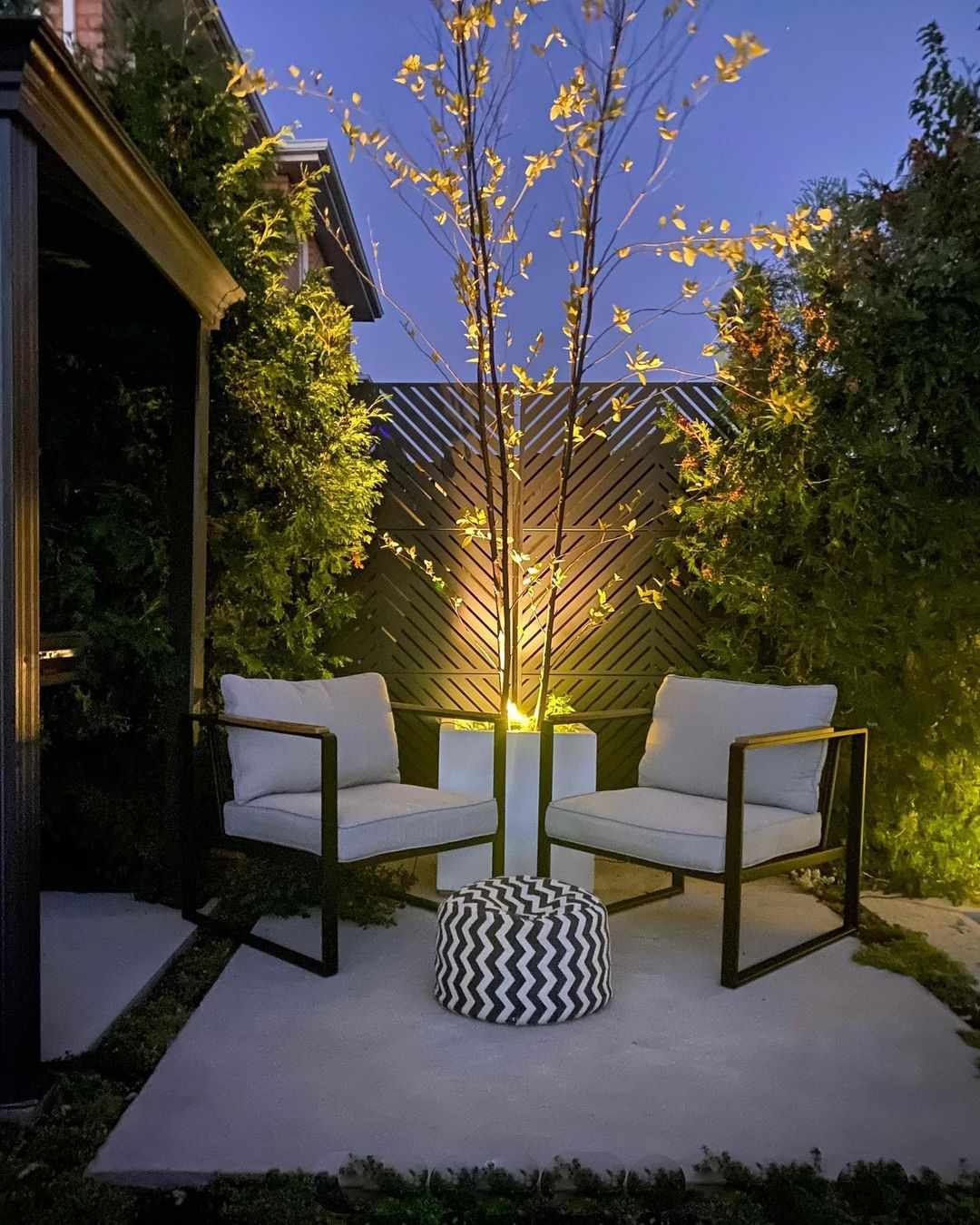
4. Illuminate Trees From Below
Trees can become dramatic features at night with very simple lighting.
Instead of placing lights high in the tree, position a small spotlight near the base and aim it upward.
This technique emphasizes the trunk, branches, and foliage.
It is often called uplighting.
You do not need a powerful spotlight. A modest outdoor-rated fixture can create a noticeable effect.
Try placing the light slightly away from the trunk rather than directly against it. Experiment with the angle until you find a position that produces attractive shadows.
Uplighting works especially well with:
- Large trees
- Sculptural trees
- Palms
- Ornamental trees
- Trees with interesting bark
- Trees near patios
5. Create a DIY Lantern Corner
Lanterns can add personality to a backyard without requiring complicated installation.
Place several lanterns together near a seating area, garden bench, or outdoor dining space.
You can use:
- Metal lanterns
- Glass lanterns
- Wooden lanterns
- Paper-style outdoor lanterns
- Battery-powered lanterns
- Solar lanterns
Grouping different sizes can create visual interest.
For example, place a tall lantern next to two smaller lanterns near a chair or outdoor table.
Always choose products designed for outdoor conditions when appropriate, especially if they will remain outside in rain or humidity.
6. Use Battery-Powered Outdoor Lights
Battery-powered lighting can be useful when electrical access is limited.
Modern battery-operated lights are available in many forms, including:
- Lanterns
- Table lamps
- Spotlights
- String lights
- Decorative bulbs
- Motion lights
They are particularly convenient for temporary outdoor events.
If you frequently host outdoor dinners, a rechargeable lamp can provide portable illumination for the dining table.
You can move it whenever you change your backyard layout.
7. Add Lighting Under Outdoor Furniture
Subtle lighting underneath benches, steps, counters, or outdoor seating can create a modern appearance.
For example, low-profile LED strips can sometimes be installed beneath:
- Benches
- Outdoor counters
- Deck edges
- Railings
- Pergolas
- Built-in seating
The goal is not to make the light source highly visible.
Instead, you want the light itself to create a soft glow.
This technique can make basic outdoor furniture look more sophisticated.
8. Highlight Garden Plants
You do not need to illuminate every plant.
Choose a few attractive plants and use small spotlights to highlight them.
This works especially well with plants that have:
- Large leaves
- Interesting shapes
- Bright flowers
- Unusual textures
- Tall vertical forms
Place the light at a low angle and aim it toward the plant.
The resulting shadows can add depth to the garden.
If you have a collection of plants along a wall, illuminating only a few of them can create an attractive pattern of light and darkness.
9. Use Fence Lighting
A backyard fence can become a major design feature after sunset.
There are many affordable ways to illuminate a fence.
You can use:
- Solar fence lights
- String lights
- Small wall-mounted fixtures
- LED strips designed for outdoor use
- Lantern-style lights
Installing small lights along the top of a fence can create a soft boundary around the yard.
Another option is to attach string lights in a simple horizontal pattern.
For a more subtle effect, place lights near the ground and aim them toward the fence.
10. Try Solar Fence Caps
If you have a wooden fence with suitable posts, solar fence-post lights can provide both decoration and practical illumination.
They sit on top of fence posts and glow downward or outward after dark.
These fixtures are particularly useful because they combine several functions:
- Decorative lighting
- Boundary illumination
- Low-level safety lighting
- Architectural detail
Choose a design that complements the style of your fence and outdoor furniture.
11. Illuminate Steps for Safety
Steps should always be considered when planning outdoor lighting.
Even a beautiful backyard becomes inconvenient if people cannot clearly see where steps begin and end.
Affordable options include:
- Solar step lights
- LED strip lighting
- Small wall-mounted fixtures
- Recessed outdoor lights
- Battery-powered step lights
The light should make the step edges visible without producing excessive glare.
Avoid placing extremely bright lights directly at eye level.
12. Use Motion-Sensor Lights
Motion-sensor lights are particularly useful in areas where you want lighting only when someone is present.
They can be installed near:
- Back doors
- Side entrances
- Storage areas
- Garages
- Pathways
- Garden sheds
Motion lighting can also reduce unnecessary energy use because the light does not have to remain on continuously.
For a backyard, consider combining motion-sensor lighting for functional areas with decorative lighting for entertainment spaces.
13. Add a Lighted Outdoor Dining Table
Outdoor dining does not need to be complicated.
A simple table lamp, rechargeable lantern, or small string-light arrangement can provide enough illumination for dinner.
A portable rechargeable lamp can be especially useful because it does not require permanent installation.
Place the light where it illuminates the table without shining directly into people’s eyes.
If you use candles, consider enclosed lanterns designed to reduce the risk of the flame being affected by wind.
14. Make a DIY Mason Jar Light Display
Mason jars can be transformed into simple decorative lights.
You can place small battery-powered or solar fairy lights inside suitable jars and arrange them around your backyard.
Use them on:
- Outdoor tables
- Garden shelves
- Fence ledges
- Steps
- Plant stands
You can also hang jars from sturdy structures using appropriate outdoor-rated hardware.
The result can feel handmade and charming without requiring a large investment.
Always ensure that the components and jars are suitable for the outdoor environment and protected from moisture when necessary.
15. Create a Backyard Canopy With String Lights
If you have a pergola, gazebo, or other overhead structure, string lights can transform it into a cozy outdoor room.
Run the lights along the beams or across the ceiling.
For an intimate atmosphere, use several rows of small lights.
For a cleaner appearance, install a single perimeter line around the structure.
You can also combine overhead lights with lanterns at ground level.
This creates layers instead of relying on one source of illumination.
16. Use Candles for a Low-Cost Atmosphere
Candles remain one of the simplest ways to create outdoor ambiance.
Place them in appropriate outdoor candle holders or lanterns.
Candles work especially well for:
- Dinner parties
- Romantic evenings
- Small gatherings
- Garden seating
- Outdoor coffee areas
However, open flames require careful supervision.
Keep candles away from dry plants, curtains, paper decorations, children, pets, and anything that could catch fire.
For a similar visual effect with less concern about an open flame, use LED flameless candles.
17. Choose LED Lighting
LED lights can be an excellent choice for outdoor lighting because they are available in many forms and generally use less electricity than older traditional bulbs.
You can find LED options for:
- String lights
- Spotlights
- Path lights
- Floodlights
- Lanterns
- Step lights
- Wall fixtures
LED technology also makes it possible to use small fixtures that produce useful amounts of light.
When shopping, consider brightness, color temperature, weather resistance, and intended use rather than simply choosing the brightest option.
18. Light the Patio Border
A simple line of low-level lights around the patio can visually define the space.
This is useful when your patio blends into the lawn.
Small ground lights can create a boundary without making the patio overly bright.
You can use them around:
- Concrete patios
- Stone patios
- Brick terraces
- Decks
- Gravel seating areas
Spacing does not need to be perfectly symmetrical unless you prefer a formal appearance.
19. Add Lights to a Garden Bed
Garden beds can become much more attractive at night when a few plants are illuminated.
Rather than lighting the entire garden, choose specific focal points.
For example, you could illuminate:
- A flowering shrub
- A small tree
- A decorative grass
- A garden sculpture
This creates a visual journey through the garden.
The viewer’s eyes move from one illuminated feature to another.
20. Use Upcycled Containers as Lanterns
If you enjoy DIY projects, look around your home for suitable containers that can become decorative light holders.
Old jars, metal containers, and other weather-appropriate objects can sometimes be repurposed into lantern-style decorations.
You can use battery-operated lights inside them.
Perforated metal containers can create interesting patterns when illuminated from inside.
However, avoid modifying containers in ways that create sharp edges or unsafe electrical conditions.
21. Add Fairy Lights to Trees
Fairy lights can make a tree feel magical.
Wrap them around the trunk or selected branches.
This works especially well for:
- Small ornamental trees
- Fruit trees
- Trees near seating areas
- Courtyard gardens
Do not wrap lights excessively tightly around growing trees. Leave room for natural growth and avoid damaging bark.
Use outdoor-rated products intended for the environment where they will be installed.
22. Create a Cozy Reading Corner
If you have a backyard chair or bench, transform it into an evening reading area.
You might need only:
- One comfortable chair
- A small outdoor table
- A rechargeable lamp
- A blanket
- A few plants
Position the light behind or beside the chair rather than directly in front of the reader.
This can create a small private retreat.
23. Illuminate Outdoor Artwork
Garden sculptures, decorative walls, fountains, and other outdoor artwork can become focal points at night.
Use a small spotlight to highlight the feature.
Instead of installing many lights, focus on one important object.
This is a good example of how strategic lighting can create a high-end appearance without a high-end budget.
24. Use Downlighting From a Structure
Downlighting is the opposite of uplighting.
Instead of pointing light upward, place a suitable fixture above the area and direct light downward.
This can work from:
- Pergolas
- Covered patios
- Trees, when appropriate fixtures and installation methods are used
- Exterior structures
Downlighting can create a natural moonlight-like effect when carefully positioned.
It can also provide practical illumination for outdoor dining and seating.
25. Mix Functional and Decorative Lighting
One of the biggest mistakes people make is using only one type of lighting.
A better approach is to combine different purposes.
For example:
Functional lighting:
Path lights and step lights.
Ambient lighting:
String lights and lanterns.
Accent lighting:
Spotlights on trees and plants.
Safety lighting:
Motion-sensor lights near entrances.
This layered approach can make the backyard feel more complete.
26. Avoid Making Everything Bright
More light does not always mean better lighting.
An overly bright backyard can feel harsh and uncomfortable.
It can also make it difficult to appreciate the darker parts of the garden.
Instead, use contrast.
Let some areas remain darker while other areas receive gentle illumination.
This creates depth and atmosphere.
27. Think About Light Color
Color temperature can dramatically change the mood of an outdoor area.
Warm light often creates a cozy and relaxing atmosphere.
Cooler light can feel cleaner and more functional.
For social areas such as patios and outdoor dining spaces, many homeowners prefer warmer lighting.
For utility areas, brighter neutral lighting may be more appropriate.
The most important thing is consistency.
Using wildly different light colors throughout a small backyard can make the space feel visually disconnected.
28. Use Lighting to Make a Small Backyard Feel Bigger
Lighting can influence how large a backyard feels.
If you illuminate features at different distances, the eye naturally travels through the space.
For example, place:
- A lantern near the seating area
- Small lights along a pathway
- A spotlight on a tree farther away
- A soft light near the back fence
This creates layers.
Instead of seeing one illuminated zone, you see multiple points of interest.
29. Create a Backyard Date-Night Atmosphere
You do not need expensive decorations for a romantic outdoor setting.
Try:
- Warm string lights
- Two comfortable chairs
- A small table
- Lanterns
- Plants
- Soft outdoor textiles
Keep the lighting relatively low.
A small amount of warm light can create a more intimate atmosphere than a bright floodlight.
30. Make a Family-Friendly Outdoor Space
For families, lighting should combine atmosphere with visibility.
Use pathway lights around walking areas and brighter task lighting near outdoor dining or activity zones.
String lights can make the space festive.
Solar lights can define garden edges.
Motion-sensor lights can help around entrances.
The result should be comfortable without creating glare.
31. Light the Grill or Outdoor Kitchen
If you regularly cook outside, make sure the cooking area has enough task lighting.
A decorative light may look beautiful, but it should not be the only source of illumination around a grill or food-preparation area.
Use suitable outdoor-rated lighting that allows you to clearly see food, utensils, and surfaces.
Keep electrical components away from heat sources and water.
32. Add Lighting Around a Fire Pit
A fire pit already provides natural light, but additional lighting can improve the surrounding area.
Use low-level lights around the seating zone rather than placing bright lights directly beside the fire.
Small pathway lights can define the perimeter.
Lanterns can illuminate seating.
String lights overhead can create a cozy canopy.
The combination of firelight and subtle electric lighting can be especially attractive.
33. Use a Simple Lighting Zone System
Instead of treating the entire backyard as one space, divide it into zones.
For example:
Zone 1: Entry
Use pathway or motion lighting.
Zone 2: Dining
Use string lights or a table lamp.
Zone 3: Garden
Use accent lights.
Zone 4: Relaxation
Use lanterns and soft ambient lighting.
Zone 5: Utility
Use brighter functional lighting.
This makes it easier to control spending because you can improve one zone at a time.
34. Install Lighting Gradually
You do not need to transform your backyard in one weekend.
Start with the area you use most.
For example, if your family spends most evenings on the patio, begin there.
Add string lights and one or two lanterns.
Later, improve the pathway.
Then illuminate the garden.
Finally, add accent lighting to trees or decorative features.
A gradual approach allows you to see what works before spending more money.
35. Look for Lighting During Seasonal Sales
Outdoor lighting often becomes more affordable during sales.
Look for discounts during:
- End-of-season sales
- Home improvement promotions
- Holiday sales
- Clearance events
- Online shopping campaigns
However, do not buy simply because something is cheap.
Check the product specifications, weather resistance, brightness, power source, and intended outdoor use.
36. Consider Long-Term Cost, Not Just Purchase Price
The cheapest fixture is not always the least expensive choice over time.
Consider:
- Replacement batteries
- Electricity usage
- Bulb replacement
- Durability
- Weather resistance
- Maintenance
A slightly more expensive LED fixture may cost less to operate over a longer period.
Similarly, a cheap outdoor light that fails quickly may be more expensive than a durable option.
37. Hide Cables Carefully
If you use plug-in lighting, cable management is important.
Loose cords can create:
- Tripping hazards
- Visual clutter
- Water exposure
- Damage to cables
Use outdoor-rated extension cords where appropriate and follow the manufacturer’s instructions.
Keep electrical connections protected from rain and standing water.
For permanent installations, professional electrical work may be appropriate.
38. Protect Outdoor Electrical Connections
Outdoor electricity requires extra care.
Use fixtures and cables specifically rated for outdoor use.
Follow local electrical requirements and manufacturer instructions.
If a lighting installation involves new wiring, buried cables, electrical boxes, or permanent connections, consider hiring a qualified electrician.
Do not improvise electrical connections simply to save money.
A budget project should still prioritize safety.
39. Use Timers to Control Lighting
Timers can make outdoor lighting easier to manage.
Instead of manually turning lights on every evening, a timer can activate them according to a schedule.
Timers can be particularly useful for:
- Path lights
- Decorative lights
- Security lighting
- Seasonal displays
Smart plugs and timers can also help prevent lights from staying on unnecessarily.
Make sure any timer or smart device used outdoors is appropriate for outdoor conditions.
40. Try Smart Outdoor Bulbs
If you already have compatible outdoor fixtures, smart bulbs can sometimes add useful features.
Depending on the product, you may be able to control:
- Brightness
- Schedule
- On/off timing
- Light color
However, smart lighting is not necessary for a beautiful backyard.
If your budget is limited, prioritize basic quality lighting first.
41. Use One Focal Point
A backyard can feel more sophisticated when it has a clear focal point.
It could be:
- A tree
- A fountain
- A seating area
- A pergola
- A sculpture
- A fire pit
- A dining table
Use lighting to emphasize that feature.
Then keep surrounding lighting more subtle.
42. Create a Soft Fence Glow
Instead of directly illuminating the fence with a bright spotlight, you can create a softer glow by positioning lights near the ground and directing them toward the fence.
This technique can make the fence appear visually farther away.
It is particularly effective for small yards.
43. Light a Garden Path With Spacing
You do not necessarily need a light beside every few inches of pathway.
Use enough fixtures to visually guide people.
Alternating lights on opposite sides can create an attractive pattern.
Avoid placing fixtures where they become obstacles.
44. Use Portable Lamps
Portable outdoor lamps are an excellent budget option because they do not require permanent installation.
You can move them from:
- Dining table
- Coffee table
- Bench
- Outdoor kitchen
- Reading chair
This flexibility is especially useful if you frequently change your furniture arrangement.
45. Add Lighting to a Pergola
A pergola can become an outdoor room with simple lighting.
Try:
- String lights around the beams
- Hanging lanterns
- Recessed fixtures where suitable
- Small spotlights
- Pendant-style outdoor fixtures
Avoid filling every beam with lights.
A restrained design often looks cleaner.
46. Use Light and Shadow as Decoration
One of the most affordable design techniques is using shadows.
A spotlight placed behind a plant can cast its silhouette onto a wall.
A lantern with patterned openings can project shapes onto nearby surfaces.
Tree branches can create beautiful shadows when illuminated from below.
This means you are not just lighting objects—you are also designing the shadows they create.
47. Make a Small Backyard Look Expensive
You can create an upscale appearance without expensive equipment by focusing on consistency.
Use:
- Similar bulb colors
- Matching fixtures
- Simple spacing
- Hidden cables
- Warm lighting
- Carefully selected focal points
Avoid using too many unrelated styles.
A small number of coordinated lights can look more polished than a large collection of random fixtures.
48. Budget Lighting for a Rental Home
Renters may not be able to install permanent wiring.
Fortunately, there are many temporary options.
Try:
- Solar lights
- Battery lanterns
- Portable lamps
- Removable hooks where appropriate
- Freestanding lights
- Solar string lights
These options can be moved when you relocate.
Always check rental rules before attaching anything permanently.
49. Lighting for a Tiny Backyard
Small spaces benefit from subtle lighting.
Avoid large floodlights unless there is a specific reason for them.
Instead, use:
- One string-light canopy
- Two or three lanterns
- Small pathway lights
- One accent light
- A portable table lamp
The goal is to create depth without visually overcrowding the space.
50. Lighting for a Large Backyard
Large yards can require more planning.
Divide the space into zones and prioritize areas that receive the most use.
You might illuminate:
- Main patio
- Primary pathway
- Garden feature
- Fire pit
- Pool area
- Outdoor kitchen
You do not need to illuminate every corner.
Dark areas can actually add mystery and depth.
51. Poolside Lighting on a Budget
Pool areas require special attention to safety.
Use fixtures specifically designed and rated for poolside environments.
Avoid placing ordinary electrical products near water.
For decorative purposes, you can consider suitable floating lights or solar lights designed for the intended environment.
Always follow manufacturer instructions and applicable electrical safety requirements around pools.
52. Use Lighting to Define Seating Areas
If your backyard has multiple seating areas, lighting can help visually separate them.
For example:
Dining area: string lights
Reading area: portable lamp
Fire pit: low-level pathway lights
Garden bench: lantern
This creates a feeling of separate outdoor rooms.
53. Make Your Own Lighting Budget
Before shopping, establish a maximum amount.
Then divide it into categories.
For example:
- 40% for the main seating area
- 20% for pathways
- 15% for garden accents
- 15% for safety lighting
- 10% for decorative extras
The exact percentages are not important.
The idea is to prevent decorative items from consuming the entire budget while important safety lighting remains unfinished.
54. Common Outdoor Lighting Mistakes
Even inexpensive lighting can look good if planned correctly.
Avoid these common mistakes.
Using Too Many Lights
Overlighting removes contrast and can make the backyard feel harsh.
Using Different Light Colors Everywhere
A mixture of very warm, cool, and colored bulbs can look chaotic.
Ignoring Safety
Loose cords and poorly protected electrical connections can create serious hazards.
Lighting Everything Equally
A backyard with uniform brightness often lacks depth.
Buying Without Measuring
You may purchase too many fixtures or discover that cables are too short.
Ignoring Weather Conditions
Outdoor products should be appropriate for the environment in which they will be used.
Creating Glare
Avoid positioning bright lights where they shine directly into people’s eyes.
55. A Simple $50 Backyard Lighting Concept
Even with a very limited budget, you can create a noticeable improvement.
For example, you might prioritize:
- A small set of solar pathway lights
- One string-light strand
- A rechargeable lantern
Install the string lights around the main seating area.
Place solar lights along the walkway.
Use the lantern on the table.
This creates three layers of lighting:
- Ambient
- Functional
- Portable accent
56. A Moderate Budget Lighting Concept
With a larger budget, you could combine:
- Solar pathway lights
- String lights
- Tree spotlights
- Fence lights
- Outdoor lanterns
- Motion-sensor entry lighting
The key is still strategic placement rather than simply increasing the number of fixtures.
57. The Best DIY Approach
If you enjoy DIY projects, start with non-electrical decorative lighting.
Solar lights, battery-powered lamps, lanterns, and outdoor-rated string lights can offer significant visual impact without requiring complex electrical work.
Save permanent wiring projects for qualified professionals when necessary.
58. Outdoor Lighting and Landscaping
Lighting should work together with landscaping.
A beautiful plant can become a nighttime focal point when illuminated correctly.
A pathway can look more defined when bordered with low-level lights.
A retaining wall can gain depth when softly illuminated.
Think of lighting as another layer of landscaping.
59. Lighting a Backyard Garden on a Budget
A simple garden lighting plan might include:
- Solar path lights near the entrance
- One spotlight on a tree
- Small lights around a seating area
- Lanterns near a bench
- String lights above a small patio
This can transform the garden without changing the plants themselves.
60. Think About the View From Indoors
Your backyard is not only viewed from outside.
At night, you may see it through windows and doors.
Think about what the garden looks like from inside your home.
Place a few lights in visually important areas so that the backyard remains attractive even when viewed through a window.
This is especially useful for living rooms and dining rooms facing the garden.
61. Use Warm Lighting for Relaxation
If your main goal is relaxation, prioritize warm, low-intensity lighting.
A combination of:
- Warm string lights
- Lanterns
- Soft pathway lights
- Small plant spotlights
can create a peaceful environment.
62. Use Brighter Lighting for Outdoor Work
If you use part of your backyard for practical tasks, you may need brighter task lighting.
Examples include:
- Grilling
- Food preparation
- Gardening
- Repairs
- Cleaning
Keep task lighting focused on the work area rather than flooding the entire backyard.
63. Seasonal Backyard Lighting
Outdoor lighting can change with the seasons.
In summer, string lights and garden lanterns can support outdoor dinners.
During autumn, warm lanterns can complement seasonal decorations.
During winter, weather-appropriate decorative lights can brighten the landscape.
During spring, garden accent lights can highlight new flowers and plants.
64. Outdoor Lighting for Parties
For parties, combine overhead and low-level lighting.
String lights can illuminate the main area.
Lanterns can mark pathways.
Portable lamps can illuminate tables.
Accent lights can highlight garden features.
Avoid placing extremely bright lights in the center of the entertainment area.
Guests generally feel more comfortable when light levels are pleasant rather than intense.
65. Keep the Design Simple
The most important budget-friendly lighting lesson is simplicity.
You do not need dozens of fixtures.
You need the right fixtures in the right places.
A few well-positioned lights can completely change how a backyard feels.
Think about:
Where people walk.
Where people sit.
What you want them to notice.
Where safety matters.
Then light those areas.
Conclusion
Transforming your backyard with outdoor lighting does not have to involve a major renovation or a large budget. Affordable solar lights, string lights, lanterns, LED fixtures, portable lamps, and carefully positioned spotlights can dramatically improve an outdoor space.
The secret is not simply adding more light. It is creating layers.
Use pathway lighting where people walk. Add warm string lights around social areas. Highlight beautiful trees and plants with small spotlights. Use lanterns for portable ambiance. Add motion lighting where practical visibility matters. Keep some areas darker so the illuminated features stand out.
Most importantly, start small.
Choose one part of your backyard and improve it first. Once you see how the lighting changes the atmosphere, you can gradually expand the design.
A modest patio can become a cozy evening retreat. A plain garden can become a dramatic landscape. A simple fence can become a glowing backdrop. Even a tiny backyard can feel like an outdoor living room.
With thoughtful placement, appropriate outdoor-rated products, and a little creativity, budget lighting can make your backyard more beautiful, comfortable, functional, and enjoyable long after the sun goes down.
Frequently Asked Questions
What is the cheapest way to add outdoor lighting?
Solar pathway lights, battery-powered lanterns, and basic outdoor string lights are among the most accessible budget options. They can provide noticeable improvements without requiring extensive installation.
Are solar lights good for backyards?
Solar lights can be useful for pathways, gardens, fences, and decorative areas. Their performance depends on sunlight, weather, battery quality, and product design, so they work best when their solar panels receive adequate daylight.
What color light is best for a backyard?
Warm lighting is often preferred for patios, dining areas, gardens, and relaxation spaces because it creates a softer atmosphere. Brighter neutral lighting may be more appropriate for task or utility areas.
How can I make my backyard look expensive with lighting?
Focus on consistency and placement. Use coordinated fixtures, warm lighting, hidden cables, and a small number of focal points. Avoid overlighting the entire yard.
Can I install outdoor lighting myself?
Some simple options, such as solar lights and battery-powered lanterns, can be easy to position yourself. Permanent electrical wiring should be handled according to local requirements and, when appropriate, by a qualified electrician.
Are LED lights good for outdoor use?
Outdoor-rated LED lights can be a practical choice because they are available in many fixture types and can provide efficient illumination. Always select products specifically intended for outdoor conditions.
How many outdoor lights do I need?
There is no universal number. The amount depends on the size of your backyard and your goals. Start with important areas such as pathways, seating spaces, entrances, and major landscape features.
How do I prevent outdoor lights from looking cluttered?
Use fewer fixtures, repeat similar styles, maintain a consistent light color, and leave some areas dark. Lighting important features rather than every object usually creates a cleaner appearance.
Can string lights stay outside in rain?
Only use string lights that are specifically rated for outdoor use and install them according to the manufacturer’s instructions. Protect electrical connections from moisture and follow applicable safety requirements.
How can I light a backyard without electricity?
Solar lights, rechargeable lamps, battery-powered lanterns, and suitable solar string lights can provide illumination without connecting to the home’s electrical system.
How can lighting make a small backyard look larger?
Create layers of light at different distances. Illuminating a nearby seating area, a pathway, and a distant tree or fence can encourage the eye to move through the space and create a stronger sense of depth.
What areas should I light first?
Start with safety and frequently used areas. Pathways, steps, entrances, patios, dining spaces, and outdoor cooking areas are usually practical starting points. Then add decorative lighting to plants, trees, fences, and garden features.